
PCV-A — Assisted Pressure Controlled Ventilation
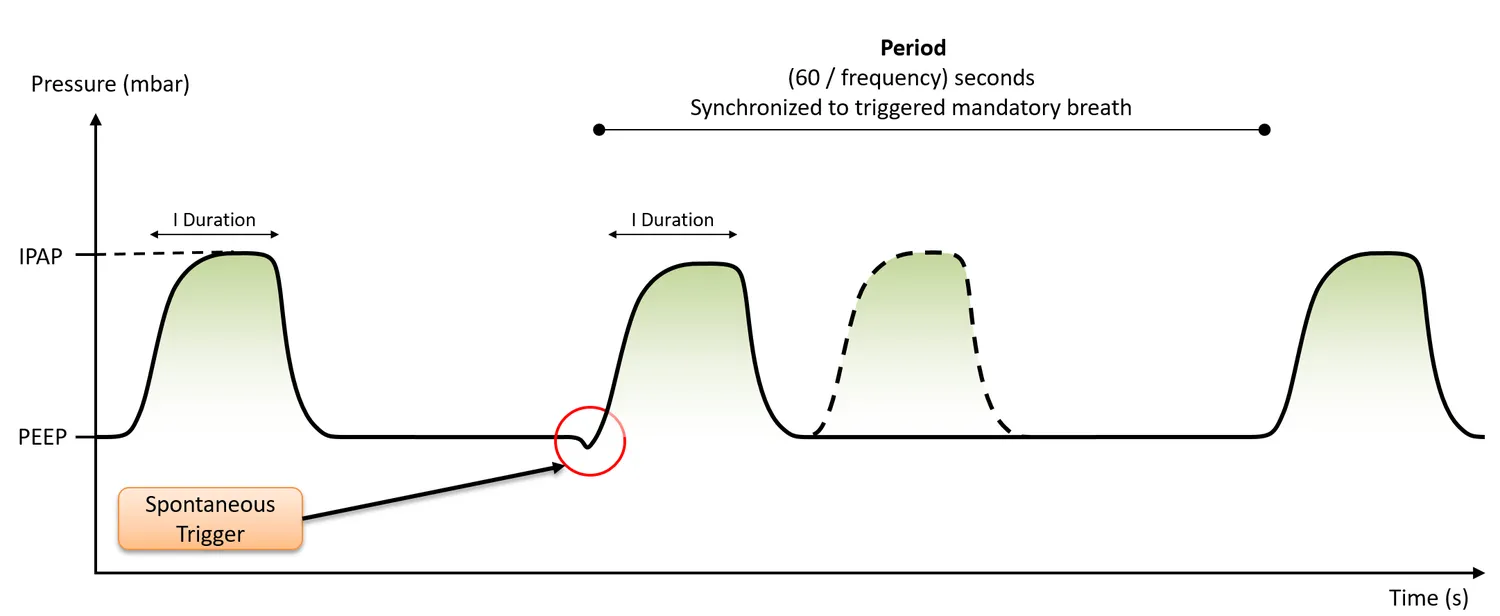
Pressure-controlled breaths the patient can trigger. Mandatory breaths are delivered at a set rate while the device also senses patient effort; IPAP is applied on every triggered or timed breath.
Waveforms
Physiological basis
PCV-A is PCV with an added spontaneous component. Unlike mandatory PCV, the patient can advance the inspiratory cycle (trigger), synchronizing the device with the patient’s neural rhythm. In this Assist-Control approach every patient effort is met with full pressure support.
This reduces patient work and improves comfort. In patients with high respiratory drive, however, applying full pressure on every triggered breath carries a risk of an air-hunger (tachypnea) cycle, so the respiratory pattern should be monitored.
Adjustable parameters 9
Pressure applied with each breath (triggered or timed).
End-expiratory pressure; important for both oxygenation and trigger sensitivity.
Mandatory backup rate; the patient can exceed it.
Fixed inspiration time for each breath.
Safety limit.
Rate of pressure rise; affects patient synchronization.
Threshold for detecting the patient’s inspiratory effort.
A wait at the start of expiration that prevents premature re-triggering.
Atelectasis prevention: a periodic deep breath.